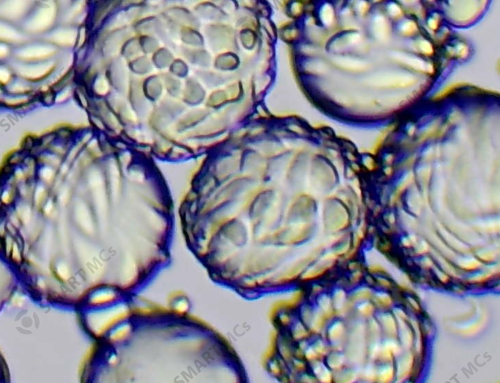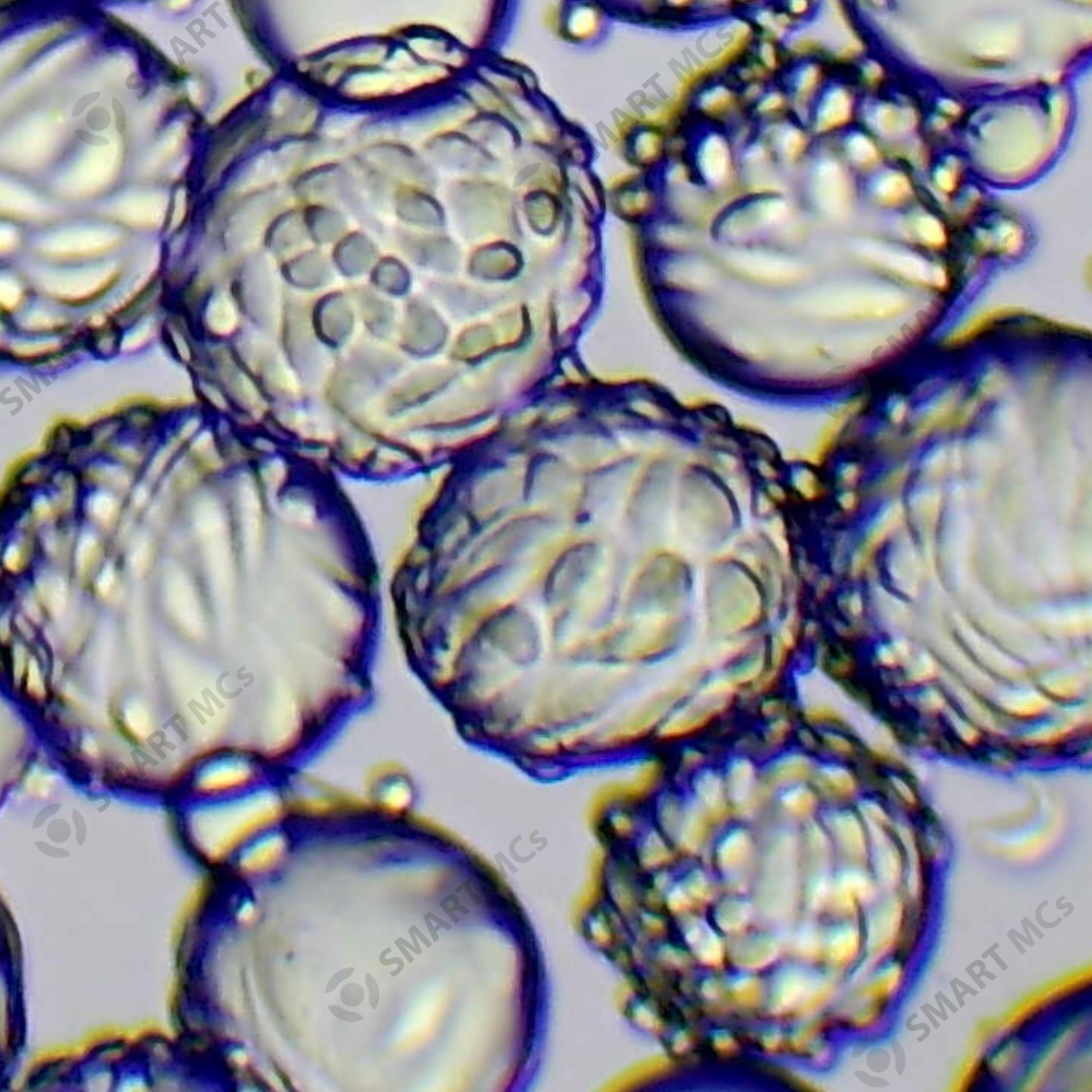
Figure 1. Uneven early cell attachment on microcarriers. Microscopy image showing variable cell attachment across microcarriers during the early seeding phase. Some carriers show visible cell attachment, while others remain sparsely populated, illustrating how early seeding conditions can affect attachment consistency.
Poor cell attachment is one of the most frustrating issues in microcarrier-based culture. In many cases, the cells appear healthy and viable, the microcarriers are present, and the culture conditions seem reasonable, yet the cells remain rounded, suspended, or only weakly attached after seeding.
This often happens even when the basic culture parameters appear to be in place:
- Cell viability is high
- Microcarriers are present at the correct concentration
- Agitation appears appropriate
- Media and supplements are correct
- Cells remain floating or show poor spreading after 6–48 hours
When attachment does not occur, the issue is rarely random. In most cases, it reflects a mismatch between cell biology, surface properties, and early process conditions.
What Cell Attachment Actually Requires
For attachment to occur, three conditions must align:
- Cells must encounter the microcarrier surface
- The surface must be compatible with the cell type
- Conditions must allow stable adhesion to form
If any of these are missing during the early seeding phase, attachment efficiency drops sharply.
Attachment is also time-sensitive. Some cells attach within a few hours, while others may require up to 48 hours depending on the cell type, microcarrier surface, media formulation, and mixing strategy. If stable attachment is not established during this early window, it can become difficult to reach the expected cell distribution and final yield.
Common Reasons Cells Fail to Attach
1. The Microcarrier Surface Is Not Suitable for That Cell Type
Microcarriers are not one-size-fits-all. Just as no single T-flask surface works perfectly for every adherent cell type, no single microcarrier surface can support every cell type equally well.
Cells rely on surface chemistry, physical properties, and available binding motifs to initiate adhesion. If these cues are absent or mismatched, cells may contact the microcarrier but fail to commit to attachment.
This is commonly seen when:
- A microcarrier surface has not been validated for the specific cell type
- Cells are moved from flask culture to microcarriers without surface screening
- Working with primary cells or stem cells with high attachment specificity
- The available coating chemistry or binding motifs do not match the cell’s adhesion needs
For well-established adherent cell lines, poor attachment often points strongly toward surface mismatch. For primary cells or more sensitive cell types, the cause may be more complex and can also involve cell handling, media conditions, or early seeding strategy.
A practical first step is to screen several microcarrier materials or coatings at small scale, such as 1–5 mL culture volume, before moving into spinner flasks or bioreactors.
2. Cells and Microcarriers Are Not Evenly Exposed to Each Other
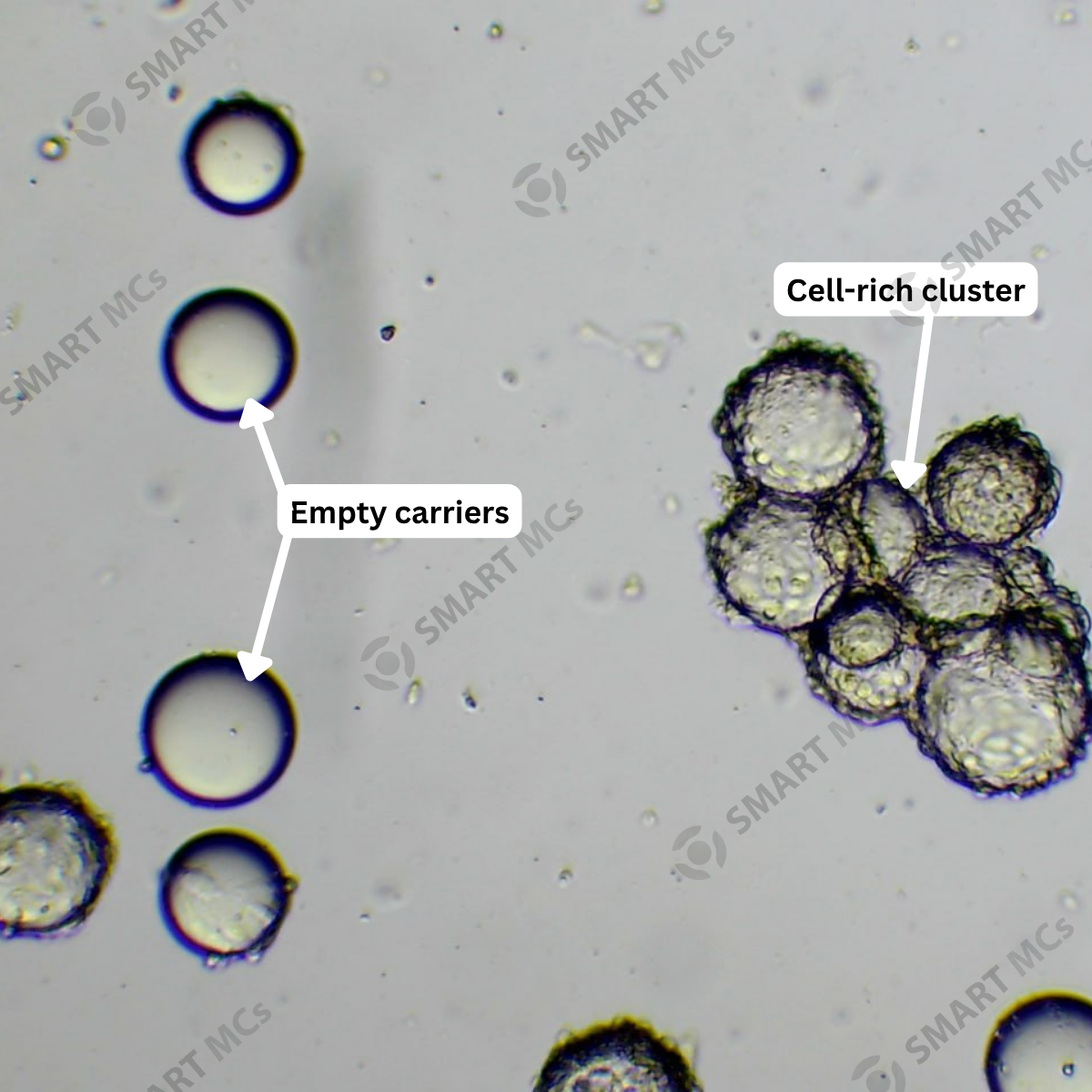
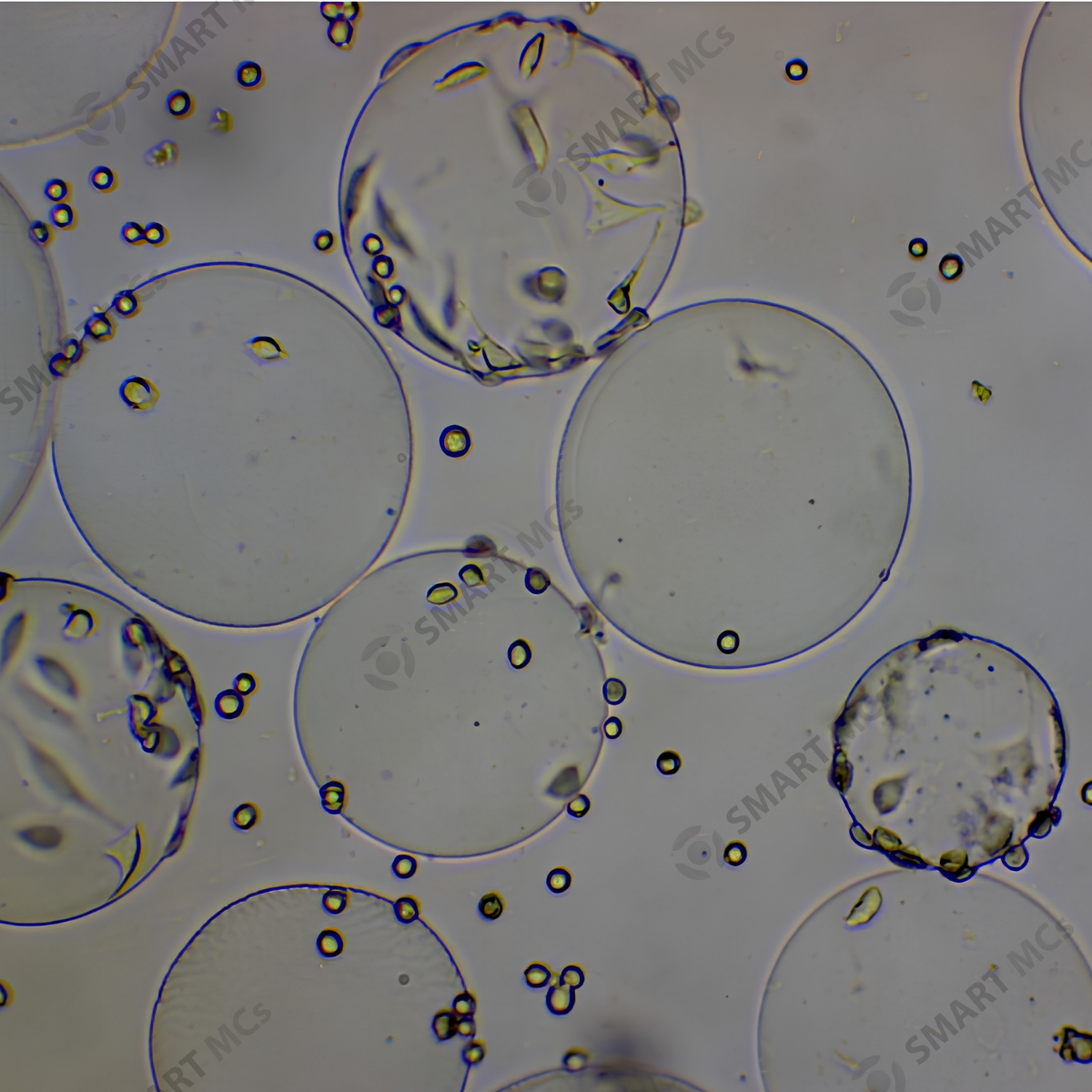
Figure 2. Example of uneven microcarrier occupancy after seeding. Empty carriers and cell-rich carrier clusters can appear in the same culture when early seeding conditions are not fully balanced
Cells need to contact the microcarrier surface as much as possible during the seeding phase. If the culture is seeded without enough mixing, cells and microcarriers can settle unevenly. This can create local cell-rich areas where some microcarriers receive too many cells, while other microcarriers receive few or no cells at all.
This uneven exposure can lead to:
- Some microcarriers remaining empty
- Some microcarriers becoming overloaded with cells
- Local cell clumping during early attachment
- Uneven cell distribution across the culture
- Lower overall attachment efficiency
Cell seeding also has a probability element. Even under good conditions, cell–microcarrier contact is not perfectly even. Similar to a Poisson distribution, some microcarriers may come into contact with multiple cells, while others have little or no cell contact. Proper mixing helps reduce this imbalance by improving cell exposure across different microcarriers in the culture.
The goal is simple: maximise useful cell–microcarrier contact during the early attachment window. Mixing should be sufficient to expose cells to as many microcarriers as possible, but gentle enough to allow stable adhesion to form once contact occurs. For many cell types, the main attachment window is around 6–24 hours, but some slower-attaching or more sensitive cells may benefit from extending the seeding phase up to 48 hours. However, a longer seeding window may not always be ideal from a workflow or economic perspective. If attachment only improves after a very long seeding period, it may also indicate that another microcarrier surface or coating should be evaluated.
3. Vessel Surfaces Can Compete with Microcarriers
Cells do not know which surface they are meant to attach to. During the early seeding phase, they may encounter both microcarriers and vessel surfaces. If the vessel surface is adhesive, some cells may attach to the flask, well plate, or reactor surface instead of the microcarriers.
This is more likely when:
- Untreated plastic or glass vessels are used
- Cells are highly adhesive, such as MSCs or fibroblasts
- Cells spend prolonged time near adhesive vessel surfaces during seeding
- Microcarriers are not well distributed during the early attachment phase
This does not mean that all settling is bad. If low-adhesion or non-adherent cultureware is used, cells that settle may still attach to nearby microcarriers rather than the vessel surface. The key issue is whether adhesive vessel surfaces are competing with the microcarriers during the attachment window.
Using non-adherent vessel coatings or low-adhesion cultureware can help reduce this competition, particularly during small-scale development. However, very adhesive cell types may still attach to vessel surfaces to some extent. The aim is to reduce unwanted vessel attachment and increase the chance that cells attach to the intended microcarrier surface.
4. Cells Are Not in an Attachment-Competent State
Cells that are stressed or recently processed may remain viable but temporarily lose their ability to attach.
This can occur following:
- Harsh dissociation or over-trypsinisation
- Prolonged time outside optimal conditions
- Rapid temperature or osmotic shifts
- High passage number or senescence
- Excessive centrifugation or mechanical stress
In microcarrier culture, this becomes especially important because cells must attach during a limited early window while suspended in a dynamic environment. Cells that attach well in a flask may behave differently after being harvested, concentrated, transferred, and introduced into a stirred or intermittently mixed system.
To reduce this risk, seed cells when they are healthy, actively growing, and recently adapted to the culture conditions being used. Avoid over-dissociation, minimise handling time, and allow cells to recover properly after thawing or stressful processing before moving into microcarrier culture.
Viability confirms that cells are alive; it does not confirm that they are attachment-ready.
5. Media or Supplement Conditions Are Not Supporting Early Attachment
Media composition can influence attachment, but this depends heavily on the microcarrier system.
Some microcarriers rely on serum proteins or attachment factors adsorbing onto the surface before cells attach effectively. Other microcarriers are designed with coatings or binding motifs that can support attachment under reduced-serum or serum-free conditions.
Issues may arise when:
- Serum or attachment factors are not suitable for that specific cell-microcarrier system
- Attachment factors are absent or depleted
- The coating chemistry requires specific proteins or supplements
- Media is changed too early after inoculation
- Cells are moved into expansion conditions before stable attachment has formed
Early attachment often requires different conditions than later expansion.
Practical Steps to Improve Attachment
1. Confirm Microcarrier–Cell Compatibility
Before optimising agitation or timing, ensure the microcarrier surface is appropriate for your cell type. Surface chemistry must support stable adhesion.
A small-scale screening step is often the fastest way to identify whether the issue is surface-related. Testing multiple materials, coatings, or stiffness options in a small volume, such as 1–5 mL, can help determine which surface supports the best attachment and spreading before committing to larger-scale culture.
2. Control the First 48 Hours
The first few hours after seeding are critical because this is when cells first contact the microcarriers and begin forming stable attachment.
For many systems, a useful starting approach is intermittent mixing:
- Mix gently for around 5 minutes to help distribute cells and microcarriers evenly
- Stop mixing for 2–3 hours to allow cells enough time to settle onto microcarriers and attach
- Repeat or adjust this pattern depending on the cell type, microcarrier surface, and vessel format
The reason for this approach is simple: cells need to meet the microcarriers, but they also need enough quiet time to stay on the surface and form stable adhesion. If there is no mixing, cells and microcarriers may distribute unevenly. If mixing is continuous or too strong too early, cells may contact the microcarriers but fail to remain attached.
Intermittent mixing is not required for every system. Some highly adhesive cell–microcarrier combinations can go directly into gentle stirring. However, for cells with slower or more sensitive attachment, intermittent mixing is often a good starting point for optimisation.
The goal is to balance two things during the first 48 hours: cell–microcarrier contact and stable cell attachment.
3. Optimise, Don’t Simply Increase, Agitation
Agitation should support cell–microcarrier contact without disrupting early adhesion. Too little mixing can lead to uneven exposure, while excessive mixing can prevent stable attachment or increase shear stress.
The right condition is usually the lowest level of mixing that keeps microcarriers reasonably distributed while still allowing cells to attach.
4. Assess Cell Handling Prior to Seeding
Attachment success begins before inoculation. Confirm cell viability (>90%) and minimise processing stress prior to seeding. Compromised cells will not recover attachment performance in the bioreactor
5. Adjust Seeding Media If Needed
If attachment is weak, the first 12–48 hours may need to be optimised separately from the expansion phase, for example by adjusting serum or attachment factors, pre-coating or conditioning the surface, modifying seeding density, using intermittent mixing, reducing the working volume during early attachment, or delaying media change until cells have attached and started spreading.
A Practical Checkpoint
If cells are not attaching, ask:
“During the first 48 hours, did cells have sufficient opportunity to contact and attach to the microcarriers?”
If the answer is no, revisit early seeding conditions, including surface compatibility, mixing strategy, cell handling, and media composition. Later adjustments rarely compensate for missed attachment windows.
Key Points to Remember
- Cell attachment is time-sensitive
- Surface compatibility is critical
- Early mixing determines encounter frequency
- Most attachment failures originate during seeding
- Small-scale screening helps identify the right surface before scale-up
Questions Researchers Commonly Ask
Final Thought
Successful microcarrier attachment depends on matching the right surface with the right cell type, while also controlling cell condition and early seeding conditions.
As a general guide, poor attachment in well-established adherent cell lines may point toward a microcarrier surface mismatch. For primary cells, stem cells, or more sensitive cell types, the cause can be broader and may also involve handling stress, media conditions, passage history, or early mixing strategy.
By screening microcarrier compatibility early and carefully controlling the first 12–48 hours of culture, researchers can improve attachment consistency and reduce one of the most common sources of variability in microcarrier-based culture.
Efficient harvest is another important part of microcarrier workflow optimisation and can be addressed separately once attachment and expansion conditions are established.
Need Help Choosing the Right Microcarrier?
If poor attachment may be related to surface compatibility, a small-scale screen can help identify the most suitable microcarrier before moving into spinner flasks or bioreactors.
Smart MCs Microcarrier Screening Kits are designed to help researchers compare microcarrier materials, coating chemistries, and stiffness options using their own cells.
A typical screening workflow begins with the Material Screening Kit, which compares selected material and coating options such as X1M, P1M, P2M animal-derived coating, and P2M xeno-free or human protein-coated options. Once the preferred material or coating chemistry is identified, a material-specific Stiffness Screening Kit can be used to compare soft, medium, and hard versions within that selected microcarrier family.
This staged approach helps reduce unnecessary variables and supports a more focused path from early attachment screening to scale-up.
For cultures where cells attach to the vessel surface instead of the microcarriers, Smart MCs also offers a Non-Adherent Coating to help create low-attachment vessel surfaces. This can support more consistent cell–microcarrier interaction during seeding, small-scale screening, and microcarrier process development.