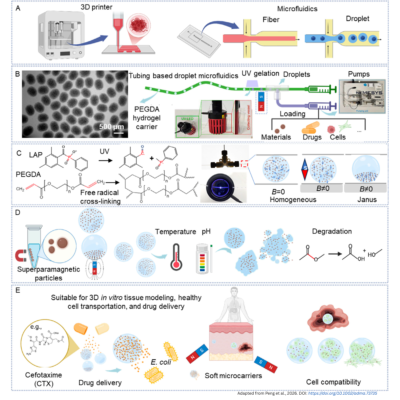
Figure 1. Overview of PEGDA-based magnetic hydrogel microcarrier fabrication and applications, including microfluidic bead generation, magnetic particle incorporation, UV photopolymerisation, homogeneous and Janus-type microcarrier formats, tunable degradation influenced by temperature and pH, and potential applications in soft robotics, 3D cell culture, cell transport, and drug delivery.
Microcarriers are often described as small surfaces for growing adherent cells. However, microcarrier design can extend beyond cell expansion alone. A recent study by Peng et al. (2026) demonstrates how hydrogel microcarriers can be engineered to encapsulate drugs or living cells, respond to magnetic fields, and degrade over time.
This study did not use Smart MCs microcarriers or Smart MCs products. We are highlighting it as an example of how microcarrier-based materials are being explored for drug delivery, 3D cell culture, spheroid culture, tissue engineering, and disease modelling.
What the Researchers Made
The authors fabricated soft hydrogel microcarriers using poly(ethylene glycol) diacrylate, or PEGDA, a photocrosslinkable hydrogel material. The microcarriers were produced using droplet-based microfluidics, where small hydrogel droplets were formed and then crosslinked using UV light.
To make the microcarriers magnetic, the researchers mixed superparamagnetic particles into the PEGDA precursor solution before UV crosslinking. Once the hydrogel network formed, the magnetic particles were retained inside the microcarrier matrix.
The resulting microcarriers were approximately 500 µm in diameter and were tested with magnetic particle loadings up to 10% v/v. The authors showed that magnetic particle concentration and UV exposure time were both important. Higher magnetic particle content increased magnetic responsiveness, but excessive particle loading could interfere with UV polymerisation because the particles absorb and scatter light.
The researchers also prepared two types of magnetic microcarriers. In one format, the magnetic particles were distributed throughout the bead. In another, a magnet was placed near the UV polymerisation area, pulling the particles to one side before gelation and creating a Janus-type microcarrier with a magnetic-rich region.
Result 1: The Microcarriers Could Be Moved Using Magnetic Fields
A central result of the paper was that the PEGDA microcarriers could be guided using external magnetic fields.
The authors tested microcarriers under different magnetic field strengths and magnetic particle loadings. Microcarrier velocity increased with magnetic field strength and with magnetic particle content. This confirmed that the embedded particles were sufficient to make the hydrogel beads magnetically responsive.
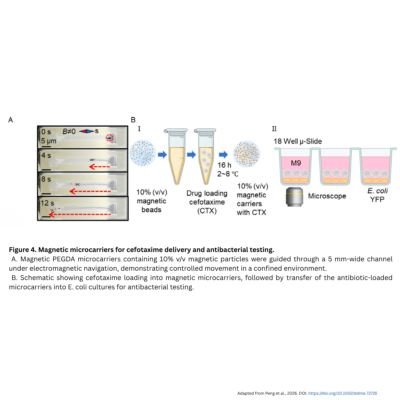
The study also demonstrated controlled navigation. Using an electromagnetic system, the researchers guided microcarriers along programmed paths, including straight and circular trajectories. They also showed movement through a confined 5 mm-wide channel, which helped demonstrate controlled positioning in a small liquid environment.
This result shows that hydrogel microcarriers can be designed to move in response to magnetic fields, rather than behaving only as passive particles in suspension.
Result 2: Hydrogel Degradation Could Be Tuned
The second major result was controlled degradation.
For many biomedical and tissue engineering applications, a material may need to remain stable during handling or delivery, then degrade after a certain period. The authors investigated how PEGDA microcarrier degradation changed depending on formulation and environmental conditions.
They found that degradation was influenced by:
- PEGDA molecular weight
- PEGDA concentration
- temperature
- pH
- magnetic particle content
PEGDA700 microcarriers were more stable and remained intact for several weeks at 37°C under the tested pH conditions. PEGDA6000 microcarriers degraded faster, especially at lower polymer concentration. PEGDA6000 microcarriers prepared at 7.5% w/v degraded within approximately 2 days across the tested pH environments.
Temperature had a strong effect, with elevated temperatures accelerating hydrogel dissolution. Acidic and alkaline pH conditions also promoted swelling and degradation. The authors further observed that magnetic particle inclusions could accelerate degradation compared with hydrogel-only microcarriers, likely because particle leaching created voids that allowed more fluid to enter the hydrogel matrix.
This result is important because it shows that microcarrier lifetime can be adjusted by changing the hydrogel formulation and surrounding conditions.
Result 3: Antibiotic-Loaded Microcarriers Reduced E. coli Growth
The researchers then tested the microcarriers for antibiotic delivery.
They loaded the magnetic microcarriers with cefotaxime, a β-lactam antibiotic, by incubating them in antibiotic solutions. The cefotaxime-loaded microcarriers were then added to cultures of E. coli.
The antibacterial effect was concentration-dependent. Without antibiotic, E. coli continued to grow. With cefotaxime-loaded microcarriers, bacterial growth was suppressed. At higher antibiotic concentrations, the authors observed reduced proliferation and bacterial cell death.
This experiment connected two functions in one system: magnetic positioning and antibiotic delivery. The microcarriers could be moved under magnetic guidance and then used to deliver an active compound in vitro.
Result 4: The Microcarriers Supported Living Cells and Spheroids
The study also examined whether the hydrogel microcarriers could support living cells.
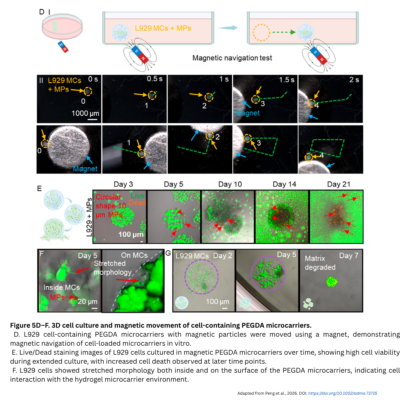
The authors encapsulated L929 fibroblasts and PANC-1 pancreatic cancer cells inside PEGDA microcarriers. L929 cells maintained high viability for up to 2 weeks in culture. Clear cell death was observed after around 20 days, which the authors suggested may have been due to nutrient and oxygen limitation in the confined 3D structure.
The L929 cells showed stretched morphology inside and on the surface of the microcarriers, indicating cell activity and interaction with the hydrogel environment. After about one week, some cells migrated out of the microcarriers and continued proliferating on the plate.
For PANC-1 cells, the authors showed that the microcarriers could support cancer spheroid culture. They also demonstrated that cell-containing microcarriers could still be moved using magnetic guidance in vitro.
This result shows that the platform could combine cell encapsulation, 3D culture, and magnetic movement under controlled laboratory conditions.
What This Means for Microcarrier Design
The main contribution of this paper is the combination of several functions in one hydrogel microcarrier system.
The authors demonstrated microcarriers that could:
- encapsulate magnetic particles
- respond to external magnetic fields
- carry an antibiotic
- support living cells and spheroids
- degrade at tunable rates
This is relevant for research areas where materials need to be positioned, remain stable for a defined period, and then degrade or release encapsulated materials over time.
For tissue engineering, degradable microcarriers may support temporary 3D cell encapsulation before matrix breakdown. For drug delivery studies, magnetic guidance may help investigate localised delivery. For disease modelling, cell-containing degradable microcarriers may support 3D tumour or tissue-like model development.
Important Limitations
The paper also makes clear that the system is still at the research stage.
Although the PEGDA hydrogel matrix was degradable, the magnetic particles used in the study were not biodegradable. This is an important limitation for future biomedical translation, particularly where long-term clearance and biocompatibility are required.
The experiments were also performed in controlled laboratory settings. Further work would be needed to assess performance in more complex biological environments, including in vivo models.
Takeaway
Peng et al. demonstrated that PEGDA-based hydrogel microcarriers can be engineered with magnetic responsiveness, tunable degradation, antibiotic delivery capability, and compatibility with 3D cell culture.
The study is a useful example of how microcarriers can be designed for functions beyond adherent cell expansion alone. It highlights how material formulation can influence microcarrier movement, degradation behaviour, and interaction with cells.
Reference
Peng, X., Song, L., Mruga, D., Bakhmat, V., Dzyadevych, S., Guo, L., Shakeel, S., Illing, R., Bezsmertna, O., Wang, X., Posselli, N. R., Misra, S., Hauser, S., Pietzsch, J., Kopka, K., Makarov, D., Janićijević, Ž., Zhao, X., & Baraban, L. (2026). Soft, Degradable, and Magnetic Microcarriers for Encapsulation and Guided Transport of Drugs and 3D Spheroids. Advanced Materials. https://doi.org/10.1002/adma.73735
Disclaimer
Smart MCs is not affiliated with the authors of this work. This study did not use Smart MCs microcarriers or Smart MCs products. This post is intended to highlight general use cases of microcarriers and hydrogel materials in biomedical research, tissue engineering, and drug delivery for educational purposes.
Smart MCs PEGDA and Microcarriers
While this study did not use Smart MCs products, it highlights the importance of hydrogel selection in microcarrier design. PEGDA is widely used as a photocrosslinkable hydrogel for applications such as 3D cell culture, tissue engineering, bioprinting, drug delivery, controlled release, microfluidics, and photolithography. Smart MCs offers PEGDA hydrogel in multiple molecular weights, including PEGDA-400, PEGDA-600, and PEGDA-1000, supplied with LAP photoinitiator.
Smart MCs also develops microcarrier platforms for adherent cell culture, including P1 Synthetic Microcarriers, P2 Dissolvable Microcarriers, and X1 Dissolvable Microcarriers. P1 is a fully defined synthetic microcarrier for adherent cell expansion, while P2 and X1 are dissolvable microcarrier systems designed to simplify cell recovery by reducing the need for mechanical separation or filtration.
Our product range also includes hydrogels, reagents, consumables, microfluidic materials, and microspheres for cell culture and biomaterials research.
For PEGDA, hydrogels, microcarriers, and other Smart MCs products, please visit our product page or contact info@smartmcs.com.au.